



Mind Mapping
Active
Learning
Value Based
Learning
Collaboration
Self Directed
Learning

What Is This?
Mind mapping is a tool which enables students to visualize the links between ideas and concepts. Using mind maps encourages students to group ideas and organize information as they learn. As opposed to traditional writing or summarizing, mapping enables students to visualize their thoughts therefore making information more memorable. Mind maps help students note the most important information using keywords, creating a graphic visual form to make connections between facts and ideas.
How To Use It?
First, identify the main topic of study, then present this main topic in the middle of the map. Have students add sub-ideas and terms to the map as they learn or at the end of the learning process. Each sub-term can be explained or elaborated with relevant information presented on the map. Teachers can suggest different graphic ways of representing connections between the terms. Class can discuss the different ways students visualized the connections between ideas and how this may reflect different understandings or opinions.
When To Use?
Mind Mapping can be used during and after several concepts have been taught, for group brainstorming or assessing prior knowledge before teaching.
Mind mapping can be used for generating, visualizing, organizing, note-taking, problem-solving, decision-making, revising and clarifying different topics.
How To Assess?
Mind maps themselves can be used as a form of assessment. It can also be used for presentation after a learning process or as using the map as a base for a short formative feedback discussion between teacher and student.
Mind Mapping
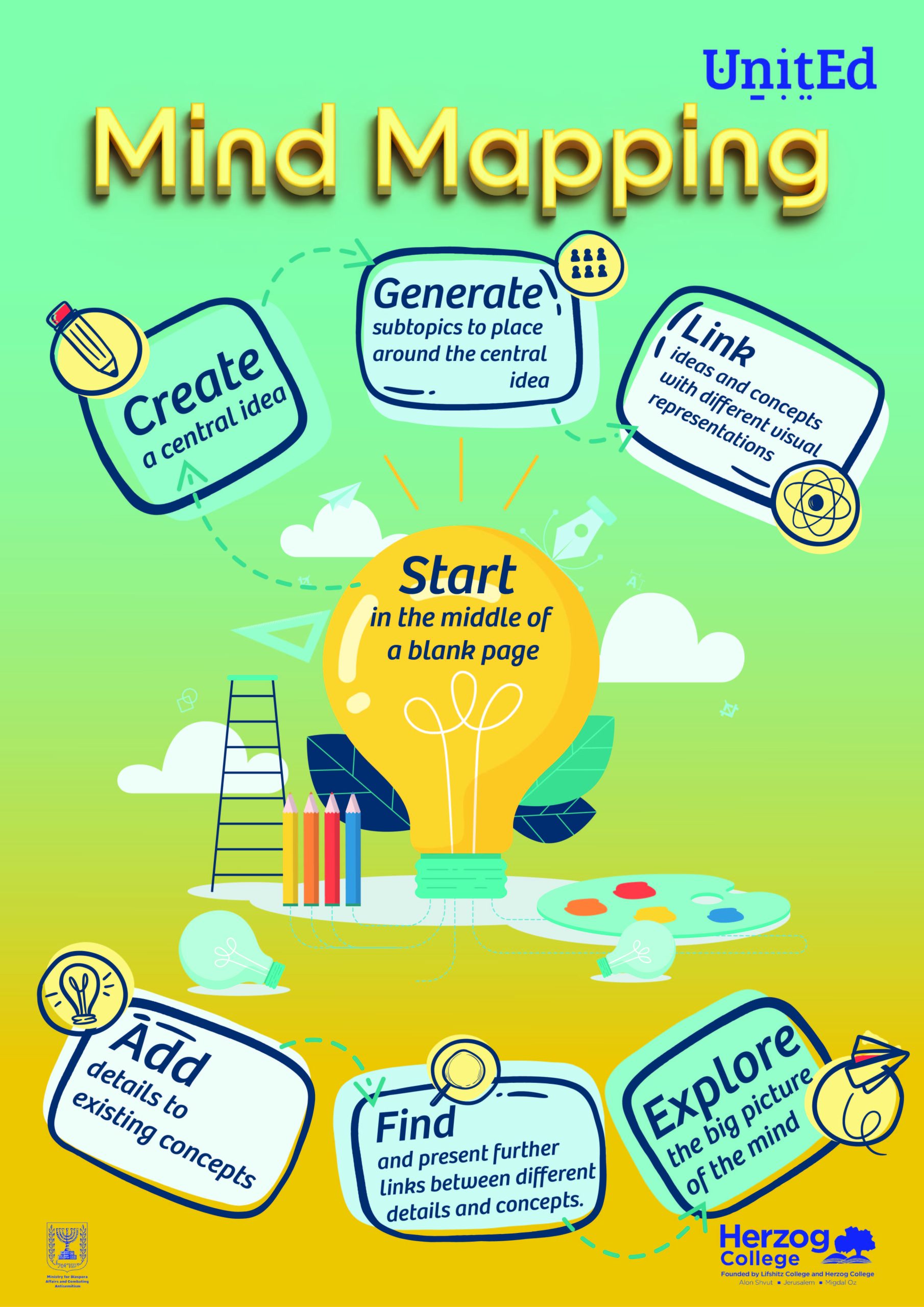
Flow
01 Read More
Create a Central Idea. The central idea is the starting point of your Mind Map and represents the topic you are going to explore.
02 Read More
Come up with three to five other ideas, then place them around the mind map topic.
03 Read More
Draw a connecting feature from the mind map main topic to each idea.
04 Read More
Expand presented concepts by adding details, ideas, tasks, and questions.
05 Read More
Draw more connecting features between each idea to its supporting details
06 Read More
Use different visual representations (colors, lines & shapes) for different types of links between ideas.
07 Read More
Analyze, discuss, and question maps to deepen understanding and egnite classroom engagement.
Previous
Next
Hang A Visual Flow In The Classroom
Download
Mind Mapping Podcast
Listen to the podcast
Podcast Worksheet
Podcast in PDF format
Printable Products
Mind Mapping-Sharing and Evaluation: For Students
A proposal for two stages of sharing and self/peer evaluation following the creation of mind maps.
Scaffolding (Preparation) for Creating a Mind Map-For Students
This is a tool, for a student’s independent work or work in groups, that will help students begin the thinking process towards creating the map.
Inspirational Links
Mindmeister – Online Mind Mapping Tool
bubbl.us – Online Mind Mapping Tool
A Learning Map Connects Instructional
