



Peer Discussion
Active
Learning
Value Based
Learning
Collaboration
Self Directed
Learning

What Is This?
Peer discussion is a structured practice which encourages developing ideas, opinions and understandings, both individually and collaboratively. Peer discussion involves students discussing concepts or ideas in small groups to ensure deep understanding. By following the steps of this practice students have a chance to think, express, listen and then rethink individually and as a group. Students who’ve actively argued for and explained their understanding retain their knowledge longer. When using peer discussion in the classroom, students also gain a sense of confidence in their ability to explain their opinions and explore further complex topics. Polling allows students to create a meta-cognitive understanding of their learning process.
How To Use It?
In the beginning of the session an idea or concept is taught followed by a question which is presented to the students. Students take a few minutes to think of their individual answers and express them in writing. To gain insight as to the range of opinions the teacher then presents a multiple choice poll. The students are then asked to choose an option which suits their individual opinion. After viewing the class poll results, the teacher forms peer discussion groups. Peers re-think in groups to try and deepen their understanding. Group discussion often results in students explaining concepts and providing clarifications to their peers regarding their opinions and choices. After peer discussion, the poll is repeated and results are discussed with the class.
When To Use?
Peer discussion can be used when presenting complex aspects or questions that require forming opinions. Peer discussion can be used as an introduction lesson to arouse curiosity, or as ways to deepen understanding of a studied concept.
How To Assess?
After discussing in groups or answering polls or votes, students can write a one-minute ted talk or make a mind map on the taught subject. Assessment can also include reflective writing on the topic of “how or why my thinking changed / what I learned from others”.
Peer Discussion
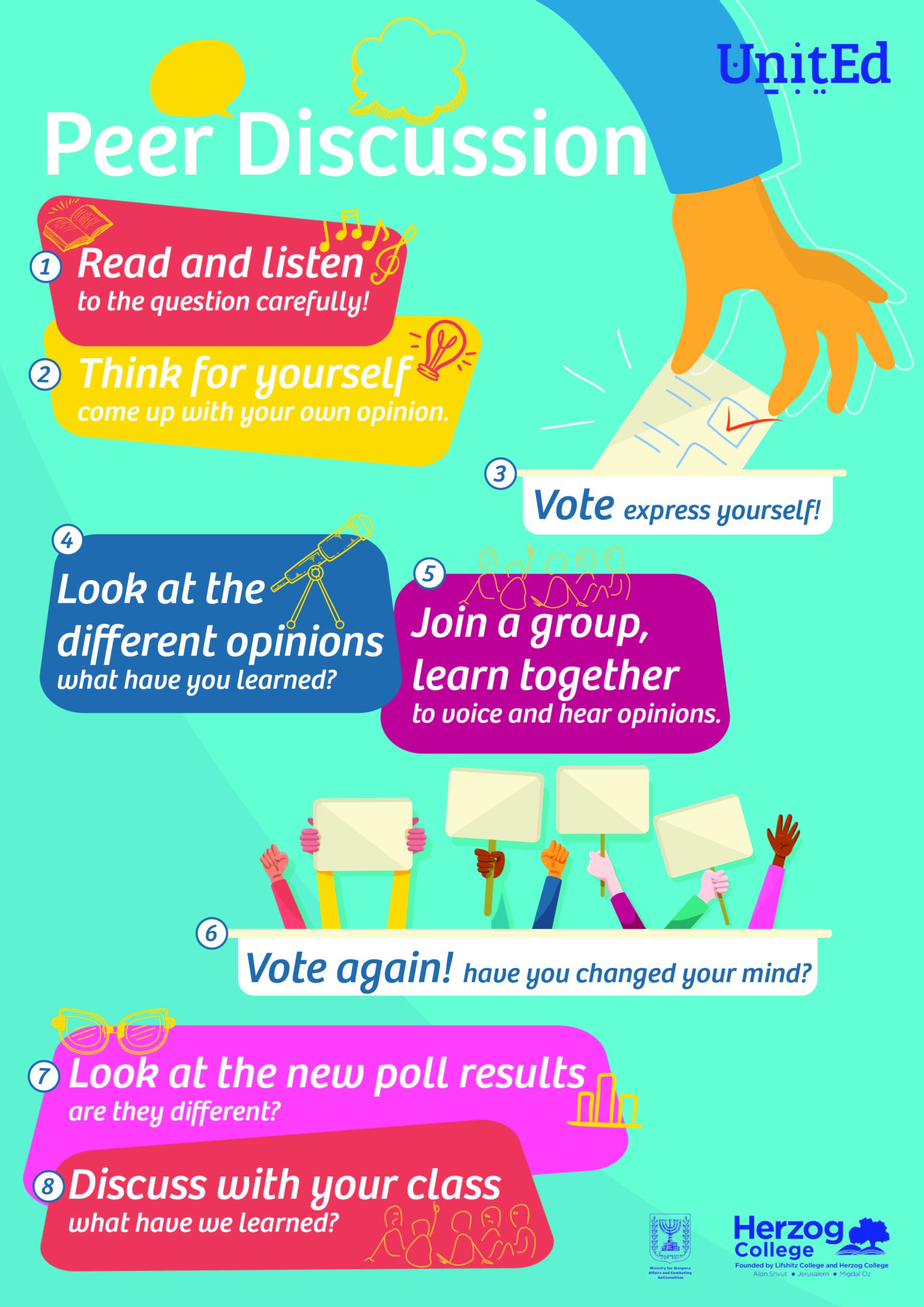
Flow
01 Read More
Present a topic and ask a meaningful question relating to it.
02 Read More
Have students think individually and express their opinion in writing.
03 Read More
Present the class with a multiple-choice polling question, have them vote for their preferred answer.
04 Read More
Pause to discuss the results of class polling.
05 Read More
Have students form peer discussion groups to discuss their individual answers.
06 Read More
After group thinking, have students individually respond to the poll again
07 Read More
Discuss the new poll results, new understandings and learning process as a whole.
Previous
Next
Hang A Visual Flow In The Classroom
Download
Peer Discussion Podcast
Listen to the podcast
Podcast Worksheet
Podcast in PDF format
Printable Products
Inspirational Links
Peer Instruction for Active Learning – Eric Mazur
Teaching Elements Peer Instruction
Why does peer instruction benefit student learning?
