



Dilemma
Active
Learning
Value Based
Learning
Collaboration
Self Directed
Learning

What Is This?
Presenting ethical dilemmas in the classroom is a practice in which students are presented with stories and situations which require decision making. These moral dilemmas require choosing between two seemingly right choices. In the process, students are encouraged to search for, and evaluate their assumptions. They are prompted to explore the reasons behind their opinions, to examine other opinions without prejudice and to make an individual thoughtful decision with confidence.
How To Use It?
Present the class with a well chosen situation, story or text. Choose materials which suggest two possible courses of action, decision or opinion formation. Have student consider these values when contemplating the dilemma:
- Honesty
- Integrity
- Promise-keeping
- Loyalty
- Fairness
- Caring
- Respect for others
- Law abiding
Have students write their views quietly by answering the question « why? » after choosing a stand, so as to avoid students influencing each other. After individual work has been done, conduct whole class discussion, think-pair-share, group discussion, peer-learning etc.
When To Use?
This teaching practice can be used as an introduction to learning value base topics or texts. It can also be used when engaging the class in current affairs discussions. Dilemmas can be used for practicing debates in the classroom, either before, or as a conclusion to learning of a specific topic or unit.
Dilemmas can be used when learning any unit or content that relates to these three domains:
- The moral domain focuses on dilemmas in which differentiated values and decisions which affect others. Moral issues usually have to do with justice and fairness or (avoiding) harm.
- The conventional domain focuses on dilemmas which have to do with social norms, traditions and rules that depend on dynamic social context.
- The personal domain focuses on dilemmas which people believe should not be governed by universal moral rules or socially determined conventions, but instead should be up to personal choice
How To Assess?
The assessment of dilemma learning can be done by examining students’ participation using a criteria that is shared with students before the lesson.
Criteria can assess these elements:
- Students can identify the dilemma and describe what defines it as such.
- Students can describe different perspectives clearly.
- Students can articulate their chosen ethical stand and explain the underlying values.
- Students can listen to other perspectives, while defending their own views.
Assessment can relate to discussion participation, using appropriate language, listening skills or writing clearly, using a pre-discussed writing format.
Dilemma
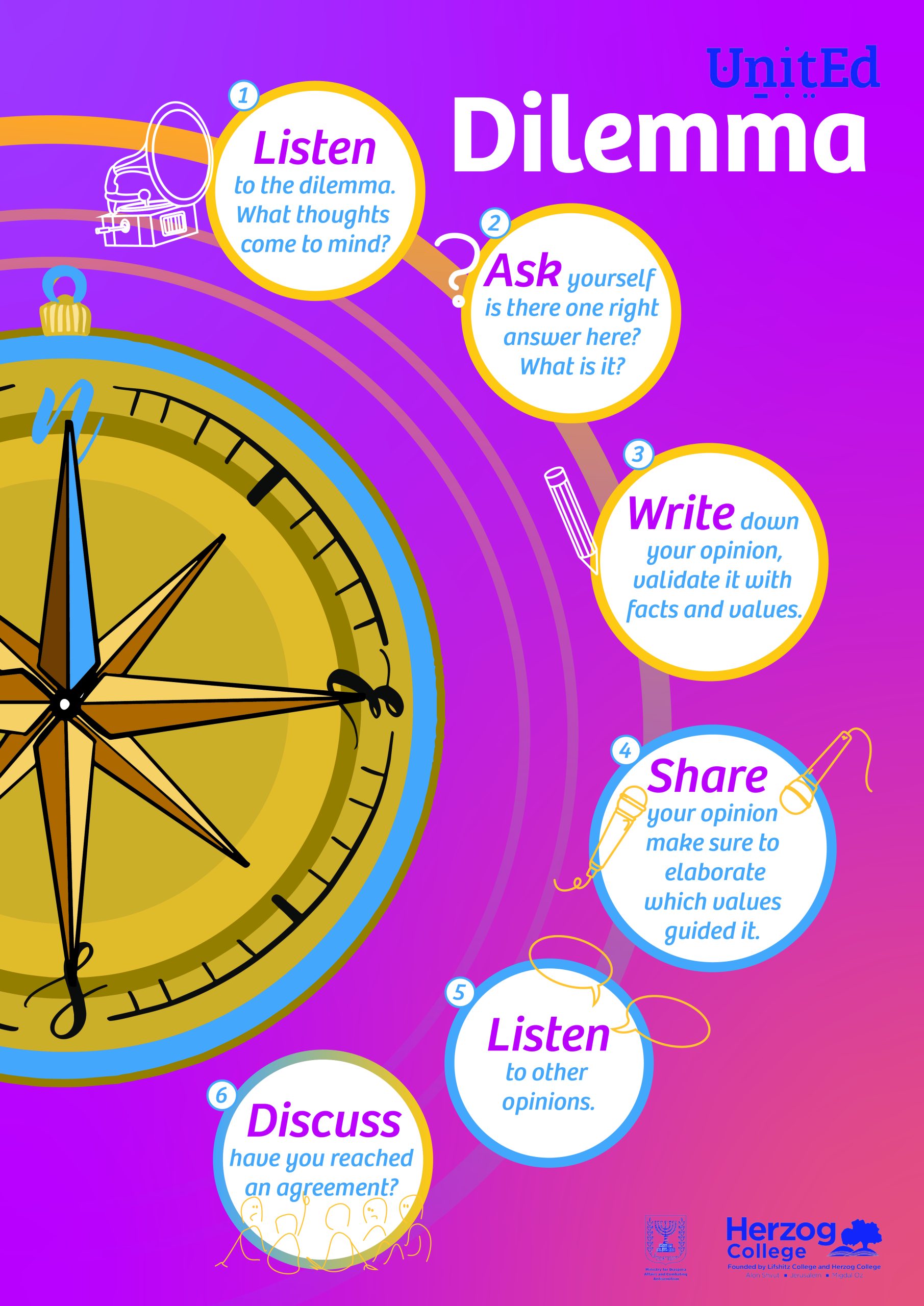
Flow
01 Read More
Present the situation or story clearly, or make sure students understand the text complexity.
02 Read More
Identify the ethical dilemma.
03 Read More
Create chances for students to form their position individually in writing.
04 Read More
Have students share their positions using collaborative teaching practices.
05 Read More
Form a class discussion, give students a chance to practice communicating respectfully and effectively, while articulating a moral decision making process.
06 Read More
Make sure students are applying facts, identifying values and informing others clearly and responsibly of their decisions.
07 Read More
Optional: have class vote, poll or reach a communal ethical decision.
08 Read More
Assess the process using clear criteria.
Previous
Next
Hang A Visual Flow In The Classroom
Download
Dilemma Podcast
Listen to the podcast
Podcast Worksheet
Podcast in PDF format
Printable Products
Diagram for Students to Prepare for Dilemma Discussion
The diagram helps the student follow the discussion taking place in the classroom and can also be a way to control and evaluate the students’ performance.
For Students: Guiding Questions for a Dilemma Discussion
The guiding questions can help the student focus on the dilemma discussed in class and prepare himself for the discussion. It can also be used to help the teacher evaluate and monitor the student’s actions.
For Teachers: A List of Values as a Base for a Dilemma Discussion
You can choose appropriate topics from the list, to hold a dilemma discussion, as well as refine the discussion around the given dilemmas.
Dilemma Discussion Assessment – Graphic Organizer
The students can use the Graphic Organizer to state their position and map, and merge the knowledge they have gained visually. The Graphic Organizer can also be used as an evaluation tool for the teacher.
Dilemma: Examples of Dilemmas for Teachers
Cards showing case studies and questions for discussion – for the student. Each card also offers guidelines for the teacher to oversee the discussion.
Inspirational Links
Ethical Dilemmas Infographics
BrainPOP movie on ethics
Ethical Questions
Teaching Values Through The Moral Dilemma
The Benefits of Teaching Ethical Dilemmas
What Students Gain From Learning Ethics in School
Ethics | Ethics Defined
